
What writers and readers are saying About On The Way Out
Since publishing On The Way Out in November 2025, I’ve been very happy with the reactions it has drawn from acclaimed writers, judges of the Gerald Griffin Competition and readers who encountered the book in entirely their own way.
As a debut novelist, I’m grateful for every response, and I’d like to share some of them here. I do so mindful of the fact that there are undoubtedly some for whom the book doesn’t work – no book pleases everyone.
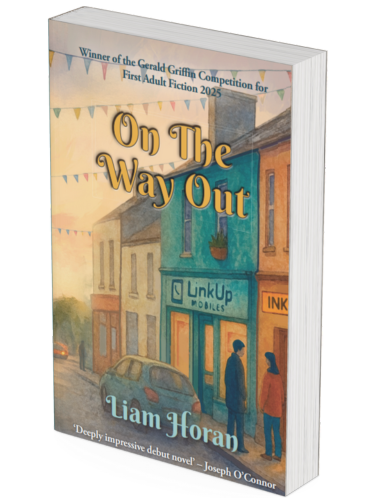 One of the first reviews came from Joseph O’Connor, the bestselling author of My Father’s House and The Ghosts of Rome. Joseph spoke about the book’s tone and texture, describing the writing as “skilful, vivid, nuanced,” and noting how it moves “from insight to humour to emotional truthfulness, often in the one crafted paragraph.”
Buy On The Way Out in your local bookshop or from our online store
From the Gerald Griffin Competition panel, Kerry Beth Neville — judge, short-story writer and author of Momma May Be Mad — offered a perspective that meant a great deal. She said the novel “navigates the lives of ordinary people with tenderness, wit, and acuity,” and that the dialogue is “sharp but not heartless,” capturing both the ache of loneliness and the resilience of community.
She saw the town itself as “a character… a bit ragged but full of possibility,” which is exactly what I wanted to achieve.
Another judge, the poet and novelist Ciaran O’Driscoll, author of The Golden Ass, responded to the mix of humour and local politics. He called the book “a deft coming together” of story and character and spoke about the “wit and savvy of small-town politics” that run through it.
His observation that the novel suggests not confrontation but “wisdom and canniness” as the better way forward felt especially apt.
On a lighter note, I loved the reaction from Louise Rooney, who read the book early. She called it “witty” and “laugh-out-loud,” saying it contains “more Irishisms than BellX1’s entire discography,” before declaring it “the chocolate at the end of your Cornetto.”
It’s impossible not to smile at that.

Declan Varley
At the launch, author Declan Varley, whose own novels include Kittyland and The Confession of Peadar Gibbons, offered a deeply personal reflection.
Declan placed the book within the Ballinrobe tradition we both come from, speaking about the influence of my late father’s district notes in the local newspaper and the everyday conversations that shaped my understanding of tone and local life.
He said the characters “breathe, falter, try again,” and that the town “beats like a heart behind every page.”
Declan has seen versions of this manuscript over the past year, so his comment that “every sentence is crafted and is dripping with meaning… not a single word wasted,” struck more of a chord with me than he probably realises.
Readers have contributed their own insights, each with a different window into the book.
Frank Foley, from Trim in Co. Meath (yes, Gaelic football fans, that Frank Foley), wrote that the novel feels “full of empathy and experience, warmth and hope,” and that it shows how community, friendship and a certain stubbornness help people navigate the twists of life. I particularly like how he described me, as the observer of local life, “hiding in plain sight”.
Sean Lowry, from Ballinahown in Athlone (yes, Gaelic football fans, that Sean Lowry), wrote that he stumbled across the book by accident and ended up reading it in one sitting. That’s something no writer ever tires of hearing. He said it brought home “how Ireland, and towns in particular, are changing.” He also loved the language.
And Maureen Nalubega, from Balla, wrote that the novel felt like “a good friend.”
Mike Maguire from Limerick had this to say: “This guy can do that thing of very plain, simple language, not overtly trying to impress anyone – just telling the tale but with as economic prose as possible and hitting all the right notes.”
Bringing these reactions together has reminded me why I wanted to write this book: to capture the rhythms and contradictions of small-town life, the humour that gets us through, and the quiet acts of “keeping on keeping on” that often go unseen.
To everyone who has taken the time to read, reflect or share a view, a sincere thank you.
Buy On The Way Out in your local bookshop or from our online store
