
Building a novel without knowing the shape of it
A novel – in my admittedly limited experience* – feels like it gets built as much as it gets written.
When I start, there isn’t a grand design**. No finished sketch pinned up on the wall. There’s simply a sense that something could stand here – maybe a town, a character, a tension humming beneath the surface.
Then it’s into the work and hope your instinct stands to you as you make your way.
 Place one piece beside another. A scene. A conversation. Or a small moment that feels like it has merit. A strong line or paragraph will present itself like a lovely piece of cut stone and, knowing that it belongs, I start to build other stuff around it.
Other days feel more like rummaging through a salvage yard. Come across a decaying piece that others would dismiss as scrap. In its rustiness, I detect something that can be spruced up and given a job to do. It might just be a filler. It’ll be grown over with grass, but I’ll haul it out carefully and give it a chance to make a name for itself.
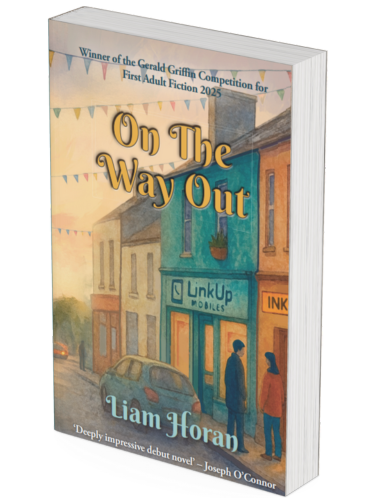
Buy On The Way Out in your local bookstore or from our online store
And then, the part I find remarkable: someone wanders in almost fully formed. Main characters often start with a distinct lack of promise. As the novelist Róisín Joyce – eminently more experienced than me, The Unlikely Pilgrimage of Harold Fry might be a good place to start with her if you haven’t read her before – has said, this character sometimes shouts “I’m here” and you cannot ignore them.
They change the dynamic. They cause trouble or resolve a row. They force a new doorway in an improbable place***.
Of course, not every addition works. Some walls have to come down. A section that looked promising throws everything off balance. I dismantle it and carry the usable pieces to the shed. The shed is crammed with false starts, abandoned chapters and out-of-favour paragraphs that once felt essential. There are even vulnerable little sentences out there, poor things. Deep down I know I’ll only reuse a few bits, but I can’t quite bring myself to clear the shed out.
The process loops: write, stand back, rethink. Move forward while being tugged backwards to reinforce something that doesn’t feel secure. Sometimes it’s just a scribbled note. Other times it’s major reconstruction.
What I’m learning is that I don’t need to see the finished structure to keep building. Yet I have control, even without a blueprint. That control carries responsibility. But, once accepted, it’s also a quiet kind of freedom.
* I’ve only written one novel – On The Way Out. In my defence, I am deep into my second novel and some of what I learned writing the first one is standing to me now. Plus, I’m not laying down rules here. I’m taking notes for myself as much as anything.
** Others plan ferociously. I don’t.
*** We live in a house that’s well over 200 years old. Some years ago, when removing the plaster to reveal the cut stone underneath, we found the outline of not one but two old doorways that had been blocked up. Somewhere in the story of this house, decisions were made that these two doorways weren’t working. They were put out of their misery. I must take a root around in the shed one of those days.
Buy On The Way Out in your local bookstore or from our online store
MORE ON THE CRAFT OF WRITING: See HERE. I’m adding to this on an ongoing basis. As I learn, hopefully you can too. Every day is school day for us all.
