How writer and editor shape the story’s path
How does a writer interact with their editor?
That’s a question I often get asked. My editor for On The Way Out was my work colleague at the Western Development Commission, Aisling Moroney.
And just as I was a debut novelist, she was a debut novel editor. Why not!
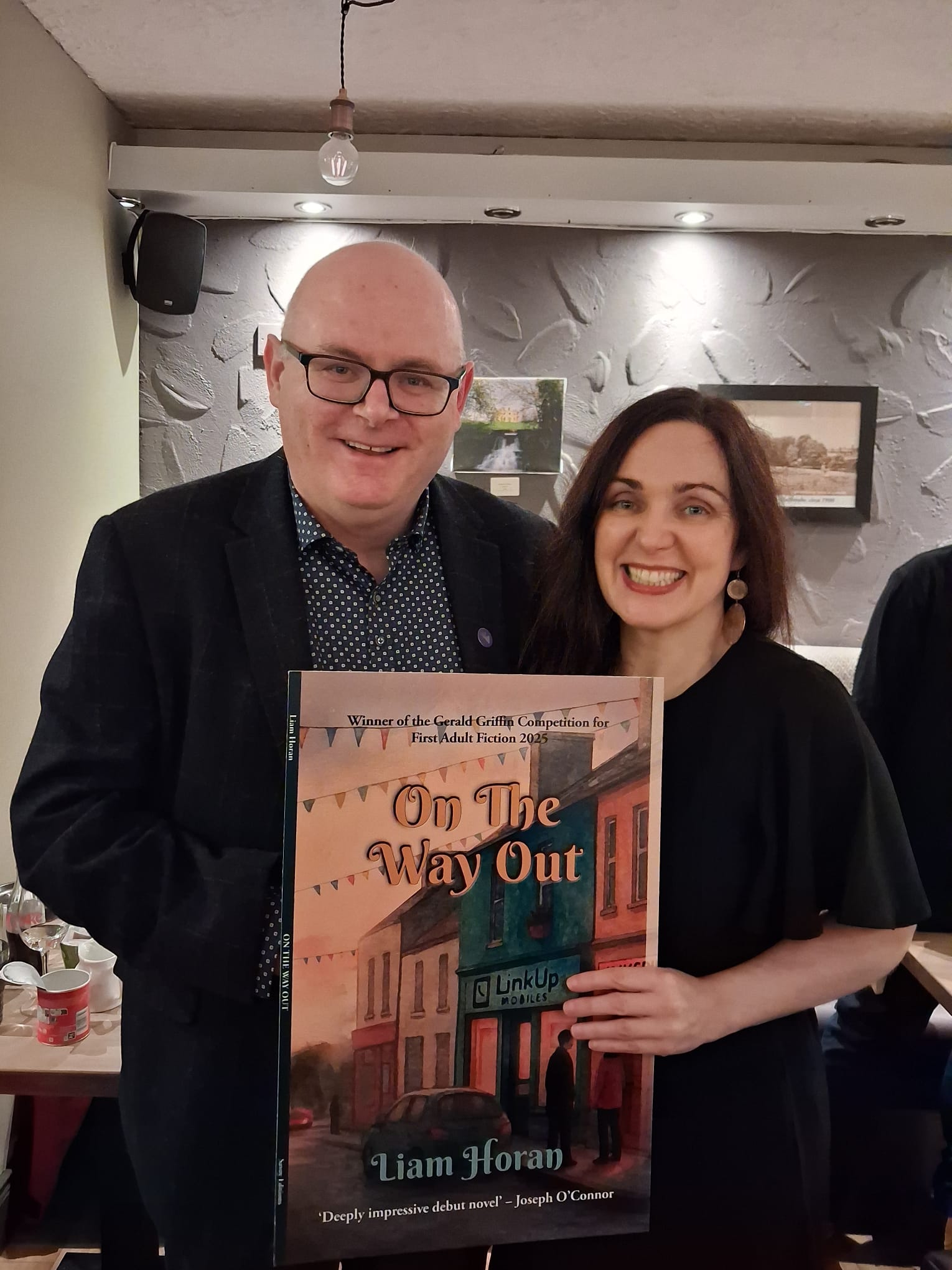
Editor of On The Way Out Aisling Moroney and author Liam Horan. Pic: Patrick Joseph Howard
Aisling has a frighteningly sharp intellect. She is very good at the high level stuff – the overall trajectory of the story.
Where is it going?
How does this work?
Is that not a false trail?
Would the character do that next?
Why would they do that next?
Would they not do this?
Does it not make sense to look at it this way?
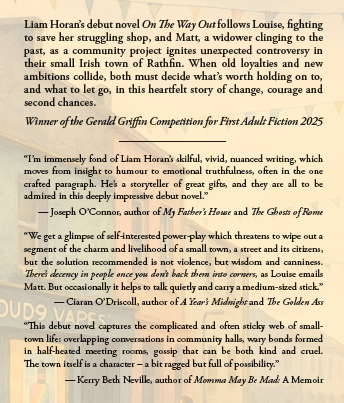
Buy On The Way Out in your local bookshop or from our online store
She also has a great eye for – and retention of – detail. She mixes the aerial combat of higher-level planning with the ground war of text editing. The modern word for this is ‘granular’ but I try to resist it.
She is a voracious reader and, I suspect, a secret writer, though she has thus far resisted my requests to see her work. That may reflect more on me than her, of course…
A writer’s relationship with an editor mirrors that of the mentor and mentee. The mentor offers guidance, suggests it might be done, and then – crucially – steps away to let the mentee do the actual work. The mentor should not overwhelm or make the mentee feel inadequate.
Likewise, the editor should not convey superiority. There should be no undertone of ‘stand back and let me at it myself’. It only works if the editor has faith in the writer’s ability, and not just in their ability to write, but to discern, to take a broad instruction and translate it into something specific.
For example, while working on On The Way Out, Aisling said that I needed to ‘convey more of the sense of anger on Gahon’s Lane’ at certain points. It was my job then to find ways of weaving that into the story.
An unhelpful, perhaps even destructive, editor, will say, ‘you need to have Matt doing this and Louise doing that, and then this should happen…’
The editor supplies the map. The writer crosses the craggy terrain.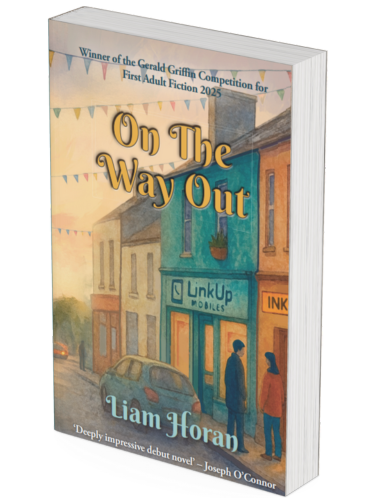
In this regard Aisling was – and still is – outstanding. She has a strong appreciation of nuance: tone, balance, the weight of the writing.
I like to write with a relatively light hand, more suggestive than explicit, and she understood that. She is highly attuned to the musicality of words and to the exact detail of dialogue.
She believes dialogue is one of the stronger elements of my writing. I’ve had an on-off relationship with dialogue over the years, even writing some pieces with none at all. I agree that it needs to be properly weighted and measured to work.
Like me, Aisling is from the west of Ireland. She has an innate understanding of the linguistic motifs that find their way into my writing and suggested subtle touches that elevate the work.
We have recently worked at plotting my next novel. I think the ultimate editor-writer relationship should begin before the writing starts at all. The editor should interrogate you before you put a word on paper to make sure you’re starting off on the right road.
 But this conflicts with another element I need to watch: planning. If I plot too elaborately, it rarely works. Just like the reader, I need to approach the book with curiosity.
I like freedom as a writer. I want a general idea of where it’s going, but I also want room to manoeuvre, to spot and capitalise on the opportunity, to go with something that’s suddenly working.
It’s like flying a plane from A to B and being allowed to divert east and west to look at other landmarks along the way. I may return to this topic in a future blog.
I consider myself fortunate to have an editor of Aisling’s capability, not least because she is a valued friend. I never doubted that her suggestions came from a position of care and respect. We tend to take criticism better from friends than enemies.
- It goes without saying – but I will say it anyway – that the foregoing is my view of the writer-editor world. Writers differ, but hopefully novels, or readers, don’t die as a result.
- Aisling didn’t get to edit this blog post. There are limits. If there are errors, they are all my own work. Alas.
MORE ON THE CRAFT OF WRITING: See HERE. I’m adding to this on an ongoing basis. As I learn, hopefully you can too. Every day is school day for us all.
